GANGWAR

Translate

GANGWAR
Custom Search

Thursday, 30 June 2011

leader of the Zetas in Cancun Rodolfo Bautista, aka The Pumpkin captured

Posted On 10:05 0 comments

Federal Police carried out during the day Wednesday, the capture of the leader of the Zetas in Cancun, Quintana Roo . The detainee was identified as Rodolfo Bautista, aka The Pumpkin. Along with the pumpkin, were captured more than four members of the criminal group known as Los Zetas, were identified as Hernan Argelio Dorantes Acosta, Elias Cruz Vazquez, and Julio Cesar Flores Zavala ; also captured José Manuel Osorio Montiel, who worked as part of the municipal police protection but provided the gunmen. Those captured were made ​​available to appropriate authorities.


Mexican Gunmen have a cloned ambulance

Posted On 10:00 0 comments

State Preventive Police received an anonymous call warning of a safe house located in Colonia San Marcos , that the city of Mexicali, Baja California. The authorities heeded the call and found the house, inside it was only personal items, mattresses and pillows, as well as the windows were sealed, but no arrests were made. It was also reported that the site was located an ambulance labeled with the letters " BC094 Red Cross , "was a cloned unit . Reports indicate that a group of gunmen had its own ambulance cloned, which was used for various violent actions.
After finding the pirate unit, some people who work in the Cruz Roja ambulance mentioned that at first glance looked cloned, also said it was a fact that dismayed, as the gunmen used the name of the institution to carry out their criminal acts .


Winnipeg biker gangs at War

Posted On 09:53 0 comments

Shots fired into a Winnipeg home - the second straight day a southeast Winnipeg home was shot up - are the result of an "active war" between rival gangs, sources say, and it's feared the violence will escalate.

Neighbours noticed smoke pouring out of a St. Vital house around the time gunshots rang out about 4 a.m. Wednesday. Winnipeg police would not confirm the home was firebombed.

A man and a woman, reportedly the parents of a high-ranking member of the local Rock Machine chapter, made it out of the home unharmed and no injuries were reported. The man who was the suspected target wasn't home at the time.

A day earlier, no one was hurt when shots were fired into a home that is allegedly associated with the Rock Machine.

Sources suggested police are investigating whether the shootings are a retaliatory move after a string of recent attacks, including one that involved a flare gun being fired into the window of a home linked to a Redlined Support Crew associate, possibly in an effort to burn down the house, a source said.

"There is an active war between the Rock Machine and the Redlined," a source told QMI Agency.

Another source said the situation has "been building up to this."

"It's going to continue to escalate," the source said. "We don't know what point it's going to reach."

The Redlined are affiliated with the Manitoba chapter of the Hells Angels. The original Rock Machine - this latest incarnation launched about three years ago - and the Quebec Hells Angels were locked in a deadly, drug-fuelled feud in the 1990s that claimed about 160 lives.

Police have been warning about a possible eruption in violence between the rival gangs for more than a year after a Rock Machine member was lured to a south Winnipeg auto shop in January 2010 and badly beaten by Redlined members.

After that, all sides have armed themselves as retribution is expected, police wrote in a February 2010 affidavit. The document also suggested Redlined Support Crew members and other Hells Angels supporters have been ordered to seek out Rock Machine members or associates and "take care of them by any means necessary."


Tuesday, 28 June 2011

Springfield police say that three men were wounded Monday in a North End shooting they believe stemmed from a gang dispute.

Posted On 21:20 0 comments


Springfield Police Sergeant John Delaney says the three victims, Justin Garafa, 21, Alberto Nieves, 20, and Geovanni Saldana, 18, all have ties to various North End gangs.

Nieves was shot in the abdomen and Saladana was shot in the chest. Both are listed in stable condition and are expected to recover, as is Garafa, who was shot in the ankle.

Police were called to Baystate Medical Center’s emergency room around 10:45 Monday night, after the victims were brought there. Delaney says that no one had called the police during the shooting, Garaffa would not talk, and detectives had to investigate to find out that it had happened near the corner of Greenwich and Huntington Streets. 18 shell casings were found in that area.

While the victim was being treated, a large crowd had gathered outside the waiting room, and was creating a commotion. Police and hospital security were able to break up the disturbance, but Delaney says Aisha Kuilan, 17, of Springfield refused to leave. He says that Kuilan swung at officers, and was swearing, shouting, and flashing gang signs.

She has been charged with being a disorderly person, and will be arraigned in Springfield District Court.


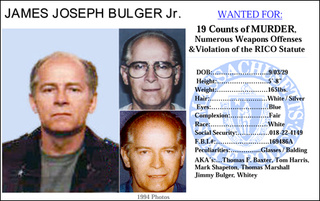
James "Whitey" Bulger's capture could cause a world of trouble inside the FBI.

Posted On 09:50 0 comments


The ruthless Boston crime boss who spent 16 years on the lam is said to have boasted that he corrupted six FBI agents and more than 20 police officers. If he decides to talk, some of them could rue the day he was caught.

"They are holding their breath, wondering what he could say," said Robert Fitzpatrick, the former second-in-command of the Boston FBI office.

The 81-year-old gangster was captured Wednesday in Santa Monica, Calif., where he apparently had been living for most of the time he was a fugitive. He appeared Friday afternoon inside a heavily guarded federal courthouse in Boston to answer for his role in 19 murders.

Bulger, wearing jeans and a white shirt, looked tan and fit and walked with a slight hunch at back-to-back hearings on two indictments. He asked that a public defender be appointed to represent him, but the government objected, citing the $800,000 seized from his Southern California apartment and his "family resources."

"We think he has access to more cash," said prosecutor Brian Kelly.

At the second hearing, Bulger took a swipe at prosecutors after Magistrate Judge Marianne Bowler asked him if he could afford to pay for an attorney.

"Well, I could, if they would give me my money back," he replied in his unmistakable Boston accent, prompting laughter in the courtroom.

Kelly implied that Bulger's cash came from illegal activities.

"He clearly didn't make that on a paper route on Santa Monica Boulevard," he said.

Prosecutors asked that Bulger be held without bail, saying he is danger to the community and may try to threaten witnesses.

"He's also, quite obviously, a risk of flight," Kelly said.

Kelly also said Catherine Greig, Bulger's longtime girlfriend who was arrested with him, told court officials that Bulger's brother may be willing to assist him in posting bail.

Bulger did not ask for a detention hearing, but his lawyer said he may later make an argument that Bulger should be released on bail while awaiting trial.

The amount of money found in Bulger's apartment confirmed a longheld belief by investigators that he kept large stashes of cash for a life on the run.

"We clearly don't think this is his last stash," Kelly said.

When Bulger walked into the courtroom, he saw his brother William, the former powerful leader of the state Senate, seated in the second row. Whitey Bulger smiled at him and mouthed, "Hi." His brother smiled back.

Greig appeared in court a few minutes later on charges of harboring a fugitive. She asked for a hearing to determine whether she can be released on bail, and one was scheduled for next week.

Bulger, the former boss of the Winter Hill Gang, Boston's Irish mob, embroiled the FBI in scandal after he disappeared in 1995. It turned out that Bulger had been an FBI informant for two decades, feeding the bureau information on the rival New England Mafia, and that he fled after a retired Boston FBI agent tipped him off that he was about to be indicted.

The retired agent, John Connolly Jr., was sent to prison for protecting Bulger. The FBI depicted Connolly as a rogue agent, but Bulger associates described more widespread corruption in testimony at Connolly's trial and in lawsuits filed by the families of people allegedly killed by Bulger and his gang.

Kevin Weeks, Bulger's right-hand man, said the crime lord stuffed envelopes with cash for law enforcement officers at holiday time. "He used to say that Christmas was for cops and kids," Weeks testified.

After a series of hearings in the late 1990s, U.S. District Judge Mark Wolf found that more than a dozen FBI agents had broken the law or violated FBI regulations.

Among them was Connolly's former supervisor, John Morris, who admitted he took about $7,000 in bribes and a case of expensive wine from Bulger and henchman Stephen "The Rifleman" Flemmi. Morris testified under a grant of immunity.

In addition, Richard Schneiderhan, a former Massachusetts state police lieutenant, was convicted of obstruction of justice and conspiracy for warning a Bulger associate that the FBI had wiretapped the phones of Bulger's brothers.

Edward J. MacKenzie Jr., a former drug dealer and enforcer for Bulger, predicted that Bulger will disclose new details about FBI corruption and how agents protected him for so long.

"Whitey was no fool. He knew he would get caught. I think he'll have more fun pulling all those skeletons out of the closet," MacKenzie said. "I think he'll start talking and he'll start taking people down."

A spokesman for the Boston FBI did not return calls seeking comment. In the past, the agency has said that a new generation of agents has replaced most or all of the agents who worked in the Boston office while Bulger was an informant.

A law enforcement official who requested anonymity because of the ongoing investigation told The Associated Press on Friday that FBI agents lured Bulger out of his., apartment earlier this week by telling him someone had broken into his on-site storage unit. The official said Bulger walked out of the apartment, was arrested without incident and consented to a search of the premises.

Some law enforcement officials said they doubt Bulger will try to cut a deal with prosecutors by exposing corruption, in part because he will almost certainly be asked to reveal what contact he had with his brothers while he was a fugitive and whether they helped him in any way.

"If Bulger talks, he would have to talk about his brothers, and I can't see that happening, said retired state police Detective Lt. Bob Long, who investigated Bulger in the 1970s and '80s."They are not going to take selective information from him - it's either full and complete cooperation or nothing."

Criminal defense attorney and former Drug Enforcement Administration agent Raymond Mansolillo said Bulger may not have any incentive to talk. "The FBI may say, 'You're going to jail or you're going to be killed. We're not offering you anything,'" said Mansolillo, who once represented New England crime figure Luigi "Baby Shacks" Manocchio.

But retired Massachusetts state police Maj. Tom Duffy, one of the lead investigators in the Bulger case, said Bulger may agree to talk if he thinks it could help his girlfriend.

"It's very possible he's concerned about her well-being - she was with him for 16 years and was very loyal to him," Duffy said. "That may be a bargaining chip for the government during negotiations."

The question of whether Bulger will be given a public defender will be decided later. A hearing was scheduled for Tuesday. He did not enter a plea.

Bulger is "looking forward to facing the charges against him," said Peter Krupp, a lawyer assigned to represent Bulger for purposes of Friday's hearing only.

Among the onlookers at the courthouse was Margaret Chaberek, who grew up in Bulger's home turf of South Boston. "I'm here to see him get what he deserves," she said.

Ina Corcoran of suburban Braintree came on her day off to witness a piece of history and sat on a bench outside the fifth-floor courtroom, saying it was like being there to see Al Capone.

"If you could go back in time to be in that courtroom, wouldn't you?" she said.


five men were found executed in different parts of the city of Torreon.

Posted On 09:39 0 comments

 The five men showed signs of extreme torture, were bound, and all had impacts firearm in different parts of the body besides narcomensaje left them, but the authorities have withheld that information. The first finding was recorded minutes before 01:00, where a man was left dead on Independence Boulevard and Calle Valdés Carrillo. Around 01:45, another corpse was left off the Northeastern University Campus Laguna. Forensic Medical Service personnel lifted the body and moved up their facilities.


Germain Perez Quiroz, head of the Department of Public Safety in the municipality of Santa Catarina, Nuevo Leon, was killed by gunmen

Posted On 09:36 0 comments

who arrived at police facilities. The unknown persons entered the office of the police command and shot him several times, being dead inside the building. Also reports indicate that the gunmen stood at least five elements of the Municipal Police. Witnesses said the gunmen were masked, and traveled at least five trucks of which only came to know that they were recent model. There has been a intense mobilization in the municipality of Santa Catarina, the Mexican Army, Federal Police, State Police and conducting operations to find those responsible.


Drug War terror was present at Peter Piper Pizza restaurant located in downtown Plaza Bella shopping Anahuac

Posted On 09:34 0 comments

, the Sendero Avenue North, in the municipality of Escobedo, Nuevo Leon. It all started when five unidentified men arrived at the parking place and a car fell Platina in white, then three of them entered the pizzeria and is seated at a table , sat for several minutes, the other two were at the gates of the business . The place was full of children and parents Family enjoying the food and games, an afternoon seemed quiet and fun. The unknown men who had just entered the place located two youths who were on a table , one of them was holding the order number, waiting their turn, when suddenly began to hear gunshots.

Chayo is the leader of the Knights Templar , now rival group La Familia Michoacana.

Posted On 09:27 0 comments

Several narcobanners signed by La Familia Michoacana appeared during the day yesterday in several municipalities in Guerrero, among which are Teloloapan Tlapehuala and Arcelia. The narcomensaje were addressed to Felipe Calderon Hinojosa, also pointed to Alejandro Poire, naming FURTHER Knights Templar . The Attorney General of the State of Guerrero, confirmed that the narcobanners were seen at different points, which were removed by members of federal forces. La Familia Michoacana blame squarely on Felipe Calderon for all people innocent who died in different events . Reports indicate that narcomensaje were similar, indicating that Nazario Moreno Gonzalez is alive, and that the government knows that's true, but give it up for dead. He also mentioned Chayo is the leader of the Knights Templar , now rival group La Familia Michoacana.


The power of video has become a tool for police and criminals alike in Mexico's bloody drug war: both share the goal of displaying their victories over the defeated.

Posted On 09:25 0 comments


The drug gangs post videos on the internet that show beheadings and torture, so as to to intimidate viewers. Some of them even end up on YouTube, although they are usually immediately removed from the popular video website.
Mexico's Federal Police, in turn, broadcast their interrogations of drug bosses before handing them over to justice officials.
The country's criminal underworld leaves little to the realm of imagination. Crude images, sarcastic smirks and startling comments recorded by the cameras allow the average Mexican a look inside the drug cartels.
Sometimes, it is hard to keep one's eyes open to such stark images of the gruesome battle that has claimed more than 40,000 lives since December 2006.
But to balance that out, the police also show reassuring footage of their capture and interrogation of criminal suspects, sending a message that they too can come out on top.
The most recent episode came this week, with the police interrogation of Jose de Jesus Mendez, better known as El Chango. Mendez, the head of the bloody drug cartel La Familia, was arrested Tuesday.
In the subsequent interrogation, he gave astonishing advice to young people to follow the path of good. Even more surprising, he gave his blessing to government and police efforts to combat the drug gangs.
'I think they are doing the right thing in arresting criminals. It's their job, and that's what they're there for, to look after the citizenry. It's great they can do that,' Mendez said, when an unidentified interrogator asked for his opinion on government actions.
He was also asked what he would tell people who are just getting started in the drug trade.
'I'd tell them to get honourable work, there is a lot of good work around. They should do their best, however. It is not just with illegal stuff that you can get by. There are thousands of ways to get by through work.'
Before the El Chango interview, police showed off other drug bosses, like Jorge Balderas Garza, alias JJ, and Edgar Valdez Villarreal, alias Barbie.
JJ, who is charged with shooting Paraguay striker Salvador Cabanas in the head, even gave two TV interviews within one day, as if he were a pop star: one after his arrest and one before being handed over to the courts. Later, he took back what he said on his lawyer's advice.
The shooting took place at a Mexico City bar in 2010. Cabanas survived but has yet to recover from the injuries.
Criminals also show off their bloody achievements on the internet. One website, El Blog del Narco (The Drug Blog), posts shocking videos of torture, beatings and even killings and beheadings that are clearly supplied by the drug gangs.
Such content would, for example, be immediately removed from mass video websites such as YouTube, which closely controls content.
But the Narco Blog administrator states on the drug website that he is not a criminal, but rather serves to display items sent to him as insight into the drug scene. Police say it's not necessary to investigate the website, and there is a belief throughout Mexico that the police find information there that is useful to their investigations.
Servando Gomez Martinez, better known as La Tuta, also knows the power of television. The former ally of El Chango at the head of La Familia currently leads the new gang, The Knights Templar.
In 2009, La Tuta gave a surreal telephone interview which was broadcast on television: He offered the government a deal and prayed to God for a chance to escape arrest on earth.
In Mexico, the videos aired by the federal police are popularly nicknamed Garcia Luna Productions, after Public Security Minister Genaro Garcia Luna.
Last year, Garcia Luna brushed off criticism for showing drug lords like Barbie.
'Why is a criminal shown before the media? First of all, I have to tell you that the criminals already aim for media impact, through extreme violence around the drug trade, making their behaviour already public,' he said.
Garcia Luna said that by broadcasting their work in arresting important suspects, the public gets the message that the state is stronger than the gangs.
The gangs aim to intimidate anyone who resists their claim to rule in a territory by using videos. Unlike in the police videos, however, their hostages sometimes finish their appearances with a gunshot to the head.


Final suspect in ‘Dead Presidents’ slayings arrested in Mexico

Posted On 09:24 0 comments

The fourth and final suspect in a 2000 gang murder in San Bernardino was arrested across the border in his native Mexico, the FBI announced on Friday night.

In a release, the FBI reported that Froylan Chiprez, 36, of Mexico was taken into custody in Tijuana by Mexican police. The Mexican government issued a provisional arrest warrant for Chiprez, who was wanted in a gang-related shooting.

Termed the Dead Presidents slayings, three other suspects have already been tried and convicted of murder over the shooting that occurred in the early morning hours of July 9, 2000, the FBI said. The allegations are that Chiprez was one of four armed men who fired weapons outside of a duplex on West Vine Street in San Bernardino, killing four men and wounding two others.

Chiprez was on parole for involuntary manslaughter at the time of the killings and escaped into his native Mexico, said the FBI.

Two other defendants in the case, Luis Alonzo Mendoza, 32, and Lorenzo Inez Arias, 29, were sentenced to death. A third man, John Adrian Ramirez, received a 12-year sentence in state prison in a plea bargain for truthful testimony.

Prosecutors alleged at a 2008 trial that Mendoza sought control of a street gang and targeted Johnny Agudo, 33, for providing information to police. Agudo, along with his brother, Gilbert, 27, Anthony Daniel Luna, 23, and Luna’s half-brother, Marselino Gregory Luna, 19, were killed in the attack.

Two of the victims were presidents of local street gangs, identifying the case as the Dead Presidents slayings.

Chiprez, once returned to the United States, will be turned over to San Bernardino police. He is a cousin to Mendoza, whose nickname is Maldito, and was a childhood friend of the Agudos, according to court reports.


COOLAROO residents who witnessed drive-by attacks on a Guildford Avenue house last week fear a gangland war could erupt in their area.

Posted On 02:22 0 comments


The house was firebombed last Tuesday and sprayed with gunfire the next morning, hours after another shooting at a house in nearby Jacana.

No one was injured in the attacks.

Broadmeadows Detective Superintendent Kevin Sheridan told the Weekly police were investigating if the incidents were linked.

The Santiago Taskforce, which has investigated the fatal shooting wars between drug families in Melbourne's north and west, has taken over the investigation.

Superintendent Sheridan said the taskforce would determine if the attacks were related to Lebanese crime circles.

"There's no evidence to suggest that it's gangland-related yet, it's too early in the investigation," he said.

He conceded the consecutive attacks on a single house was "unusual".

A witness to the Tuesday morning shooting on the Guildford Avenue address, who asked not to be named, said he saw a small truck smash in the front of the house and heard swearing before shots were fired.

"It's a rough neighbourhood, and this house has been targeted a few times," the witness said.

"It's like a war, the whole neighbourhood is sick of it."

Superintendent Sheridan tried to abate any fears, saying the gunman had targeted the Coolaroo house, rather than it being a random attack.

A heightened police presence and security would be in place at night.

The head of the Coolaroo household, Abdul Tiba, told reporters he was not scared by the latest attack, but feared for his family and residents of the neighbourhood.

"I'm worried for my family and neighbours. I feel really sorry for my neighbours," he said.

A Victoria Police spokeswoman said arson and explosives squad detectives had not yet determined what type of bomb had been thrown through the window of the family home. The investigation is ongoing.


Thursday, 23 June 2011

FBI Arrests James Whitey Bulger in California: Wanted for Murders

Posted On 09:11 0 comments

The beautiful beach town of Santa Monica, California was the site of a major arrest today of a man on the FBI's most wanted list. The elderly alleged murderer had long evading arrest. He was wanted for 21 alleged murders in Boston and then his whereabouts where unknown for over a decade.

James "Whitey" Bulger, age 81, was captured by the FBI in Santa Monica. It is not yet known how long he had been in that location. In the past he was allegedly involved in murders, racketeering and a variety of additional crimes in Boston in the years from the start of the 1970s to the mid-point of the 1980s, notes the Los Angeles Times.

The FBI had a $2 million reward for information that led to the capture of Bulger, notes Boston.com. The FBI had recently enacted a major campaign of media spots and other tools to expedite the capture of Bulger. He had previously served as a rogue informant for the FBI. Thus the agency must have had a special quest to capture him.

Bulger has long been infamous in the United States. He was supposedly the person Jack Nicholson's character in the movie "The Departed" was based on. Thus it seems a bit ironic that the FBI found him in Santa Monica, so close to the movie industry in Hollywood.

The families of the people allegedly murdered by James Whitey Bulger must be feeling strong emotions when they hear that the FBI found him. Having a beloved person murdered and never getting justice via an arrest or a trial must have been very emotionally grueling.

There will be much news coming out later about the crimes allegedly committed by Bulger. It will be fascinating to hear how the FBI found him and if anyone will get the reward money. For now, it is just a relief that a supposedly dangerous criminal is now in custody.


war on the Maniac Latin Disciples after two young girls were shot in a Northwest Side park earlier this month.

Posted On 08:40 0 comments

Police Supt. Garry McCarthy declared war on the Maniac Latin Disciples after two young girls were shot in a Northwest Side park earlier this month.

The shooter was a member of the gang and was gunning for rival Latin Kings when the girls, ages 2 and 7, were wounded on June 8, prosecutors said. The younger girl was grazed in the head and the 7-year-old was seriously wounded in the back.

“We’re going to obliterate that gang,” McCarthy told a roomful of police supervisors shortly after the shooting. “Every one of their locations has to get blown up until they cease to exist.”

Two weeks later, 120 Maniac Latin Disciples have been arrested and seven guns recovered in what police are describing as phase one of their effort to cripple the gang of 300 to 500 members.

“We’re asking the state’s attorney’s office to prosecute them to the fullest,” said Nick Roti, chief of the Organized Crime Division. “We’re going to put them out of business.”

Of the gang members arrested since the shooting, 19 remained in jail while the others posted bond.

About five have been sent back to prison for parole violations such as testing positive for narcotics, Roti said.

The crackdown is being conducted by Roti’s gang and narcotics units, as well as the patrol and detective divisions. It’s focused on the Humboldt Park and Grand-Central police districts, where many of the gang members live.

Leo Schmitz, commander of the gang enforcement unit, said the Maniac Latin Disciples have been “laying low” since McCarthy declared war on them. Investigators have tracked some to girlfriends’ apartments or addresses outside their traditional turf, he said.

The Criminal Intelligence Unit in the Cook County Jail has been providing Chicago Police investigators with hierarchy charts for about 15 factions of the Maniac Latin Disciples, said Steve Patterson, a spokesman for Sheriff Tom Dart. The charts are created by interviewing jailhouse informants.

McCarthy’s war on the Maniac Latin Disciples follows an effort last year to punish other West Side gangs. They were warned by then-police Supt. Jody Weis that they would become targets of a crackdown if one of their members committed a murder. Sixty members of the Black Souls and 100 members of the Traveling Vice Lords were arrested on federal and state charges.

McCarthy said he supports that strategy. “When groups engage in violence, they have to understand there will be consequences,” he said. “This is not going to stop.”

Antonio Bucio is the alleged Maniac Latin Disciples member charged in the June 8 shooting of the two girls. His face is tattooed with a letter “D” sprouting devil’s horns. Prosecutors said Bucio admitted to shooting at rival gang members at Avondale Park, which is north of Belmont and west of Kimball near the Kennedy Expy. Police said they have recovered the gun used in the shooting.

On Wednesday afternoon, Aquiles Pena was at the same park, watching his two young daughters swim in a pool near the play lot where the girls were shot. Pena, 50, said he has lived in the neighborhood for about two years and occasionally sees gang members hanging out, but they don’t bother him. Still, he said he’s outraged by the shooting.

“I think they should be harder on gangs around Chicago,” Pena said.


Tuesday, 21 June 2011

COME TO PICK UP YOUR TRASH CHANGO MENDEZ. BY RATS,The Knights Templar are conducting actions against the members of La Familia Michoacana

Posted On 15:15 0 comments

The Knights Templar are conducting actions against the members of La Familia Michoacana, during the morning five men appeared in different fucking performed in Michoacan. The first discovery was reported around 04:00 hours in the Tres Esquinas, in that place remained two executed men, who were handcuffed and blindfolded. Failed to identify the victims. I left a card with a narcomensaje. Later, elements of the state police came a few kilometers away from the first finding, and two others executed under the same conditions as above, had been abandoned. There were also narcomensaje.

Then near the Campo de Tiro, another man had been shot execution, he also had signs of having been tortured also were found 22 shell casings from AK-47. narcomensaje Text: " This is going to happen to all those who are Passing Data to Jesus Mendez, Chang and his collaborators. COME TO PICK UP YOUR TRASH CHANGO MENDEZ. BY RATS . "


Mexico's drug war is becoming increasingly dangerous, as police engage in more and more violent clashes with heavily armed drug-runners

Posted On 15:12 0 comments

Mexico's drug war is becoming increasingly dangerous, as police engage in more and more violent clashes with heavily armed drug-runners. But that isn't the only sign that Mexico is losing the war. Here, four chilling new revelations:

1. The cartels have 12-year-old hitmen
One of the more disturbing trends, says Carlton Purvis at Security Management, is the Mexican drug cartels' use of younger and younger foot soldiers. Police arrested 10 gang members after a bloody shootout at a Los Zetas cartel training camp, and five of the suspects were teenagers. Kids are recruited as young as 12, and the younger the hitmen are, the more dangerous, says Vanda Felbab-Brown, an expert on international conflict. "They spray an area with bullets hoping they hit a target," she says. "It's not that they're trying to do more damage, it's that they don't know how to be more precise."

2. They've also hired teenage hit women
It's not just young guys who are taking advantage of the job opportunities organized crime provides. Six women under 21 were arrested this month after a shootout near Guadalajara. Among the suspects was a 16-year-old girl who said she had been trained as a cartel "hitwoman," earning $1,000 for three weeks' work.

3. Kidnap victims are forced to fight to the death
"One of the most chilling revelations" about the drug war, says the Houston Chronicle's Dane Schiller, came in an interview with a cocaine trafficker who recently visited Texas. The trafficker — who admits to pushing a $10 million stash of cocaine into the U.S. every month — says drug gangs have kidnapped bus passengers "and forced them into gladiator-like fights to groom fresh assassins." The able-bodied men picked for the contests are given hammers, machetes, and sticks, then made to fight to the death.

4. Drug gangs are extending their reach into the U.S.
The U.S. Justice Department says Mexican underworld organizations now control most of the illegal drug trade within the U.S., with their own distribution networks in 230 cities, including Boston, Providence, R.I., and Hartford, Conn. These cities, says law enforcement expert Michael Cutler, are now "infested" with people working for cartels that have killed 35,000 people in Mexico since the drug war began.


Alleged Zetas held, linked to criminal activity,judge ordered that José María Leal Pantoja, alias "Chema" or "El Comandante Chema," and Rogelio Galván Rodríguez or Rogelio Valdez Rodríguez, alias "San Anto," be held.

Posted On 15:10 0 comments

Mexico’s Attorney General’s Office, or PGR, said Monday that two suspects will continue held for the probable commission of organized criminal activity.


The statement noted that a judge ordered that José María Leal Pantoja, alias "Chema" or "El Comandante Chema," and Rogelio Galván Rodríguez or Rogelio Valdez Rodríguez, alias "San Anto," be held.


The two suspects were detained by the military in the state of San Luis Potosi in March and are believed to be tied to the Zetas drug cartel.


The statement noted that there are indications that after Sergio Mora Cortez, alias "El Toto," was detained, Leal Pantoja was left in charge of the drug-trafficking corridor or plaza in San Luis Potosí, while Galván Rodríguez or Rogelio Valdez Rodríguez was Leal Pantoja’s bodyguard or hit man.


Mora Cortez is under detention, suspected of being tied to the slaying of ICE Special Agent Jaime Jorge Zapata on Feb. 15 in the state of San Luis Potosi.


Zapata, a Brownsville native and special agent with U.S. Immigration and Customs Enforcement, was killed by what Mexican officials have described as a squad of hit men from the Zetas.


Zapata was killed while traveling in a U.S. government SUV with diplomatic plates. ICE Special Agent Victor Avila was also wounded in the attack.


The PGR arrested Julian Zapata Espinoza, alias "El Piolín," and other alleged Zetas on Feb. 23 in San Luis Potosí. Officials say that Zapata Espinoza confessed to being the leader of a Zetas cell in San Luis Potosí and also to having led the attack on the two U.S. agents.


In late February, the Mexican navy in Saltillo in the state of Coahuila arrested Mora Cortes. The navy described Mora Cortes as an "important Zeta boss" and said he was arrested following Mexico and U.S. intelligence efforts.


The navy said that Mora Cortes was Zapata Espinoza’s immediate boss.


Monday, 20 June 2011

The gangland war in Mexico between rival Los Zetas and Gulf cartels might get a lot nastier.

Posted On 12:21 0 comments


Some law enforcement sources are confirming that Heriberto "El Lazca" Lazcano Lazcano, the reputed head of Los Zetas, was killed during a fierce shootout with the Gulf cartel in the northeastern state of Tamaulipas near Los Tomates International Bridge which connects the cities of Matamoros and Brownsville, TX as reported by The Monitor; however, "Mexico's defense secretariat issued a statement late Friday night disputing reports that Lazcano was killed."

Los Zetas is a well-armed outfit formed by deserters from the Mexican army who once provided protection to the Gulf cartel until splitting to pursue a bigger piece of the drug pie, and it recently has gone to the degenerate depths of training teenage girls as hitmen as reported by Dave Graham for Reuters.

Meanwhile, on Thursday the federal police arrested Edgar Huerta Montiel, a suspected Zetas boss in Tamaulipas, for his alleged role in the August 2010 massacre of 72 migrants from Central and South America as reported by the Latin American Herald Tribune.

And yesterday Mexican soldiers arrested 26 municipal cops in Monterrey, the capital city of Nuevo Leon state about two hours south of the Texas border, for their alleged roles on behalf of the Gulf cartel in assassinating two bodyguards to Governor Rodrigo Medina who were accused of being on the payroll of Los Zetas as reported by the Latin American Herald Tribune.


Sunday, 19 June 2011

East Palo Alto police chief declares war on street gangs in wake of shooting that left infant dead

Posted On 09:20 0 comments

East Palo Alto police Chief Ron Davis put the Norteno and Sureno street gangs on notice Friday: he's holding both of them responsible for the slaying of 3-month-old Izack Jesus Jimenez Garcia and making it his top priority to shut them down.
"If we are to protect our children and community from this type of violence and achieve true justice for the Garcia family, the accountability for the murder of baby Izack Garcia must extend beyond the two killers," Davis wrote in a letter to the community posted on the police department's website. "Our response to this tragedy must result in nothing less than the full dismantling of the Norteno and Sureno gangs in East Palo Alto."
According to police, Izack Jesus and his family were the unintended targets of a payback shooting on June 5. One of the alleged gunman, 17-year-old Fabian Zaragoza, opened fire on the family's car because he thought it was carrying Sureno gang members who had beaten him up on May 31.
A bullet hit the Redwood City infant in the head as his mother, Ivonne Garcia Lopez, tried to shield him and his 4-year-old brother, who escaped injury. Garcia Lopez was also shot in the leg and her husband Oscar Jimenez in the arm as they left a baby shower on the 400 block of Windsor Drive at 1 o'clock in the morning.
Zaragoza has been charged with murder, and a 16-year-old arrested on suspicion of a weapons violation remains a "prime suspect," Davis said.
"We cannot as a community

accept just the heinous nature of a crime where there's an environment where someone feels comfortable firing 15 bullets into a car at a baby shower," Davis told The Daily News in a phone interview Friday.
As part of the gang crackdown, the police department's violence interdiction team will keep working with the San Mateo County probation and California parole departments to visit homes and search all Norteno and Sureno members on probation or parole. Within the next two weeks, police will also meet with county, state and federal agencies.
"The purpose of this meeting is to share intelligence about these two gangs and develop a comprehensive and coordinated enforcement action plan that will disrupt their illegal activities," Davis said in his letter.
He told The Daily News it's "not necessarily going to be one event" that will dismantle the gangs, but continuous pressure. It wouldn't be the first time Davis has made busting a gang a top priority. In 2006, the police department took on the Sacramento Street gang after Officer Richard May was gunned down in the line of duty.
In addition to stepped up enforcement, Davis said he hopes the city can combat gang violence by providing services and assistance to those who want to leave gang life behind.
"If you don't want to be under surveillance 24 hours a day, then we have community support services. ... and we prefer that you do that," he said.
Although the Norteno and Sureno street gangs have long feuded with one another, Davis is hopeful a truce can be brokered through Operation Ceasefire, a grant-funded initiative launched last year to target gangs. It brings gang members face-to-face with community leaders and law enforcement, and provides social services.
"I believe we will turn this tragedy into an opportunity," Davis concluded in his letter, "to not just reduce gang violence, but change the environment that allows gangs to exist in our community."


Mexican Army were at a checkpoint located on Highway Xalapa-Veracruz

Posted On 09:13 0 comments

Mexican Army were at a checkpoint located on Highway Xalapa-Veracruz, was well aware that men are suspects to stop, but did not respond favorably.

The suspects attacked the military was so intense persecution began.Military and elements of the Ministry of Security State Public Veracruz, staged an intense battle, which ended at the same height of the Lencero this in the municipality of Emiliano Zapata .

Authorities decided to close the circulation of Xalapa-Veracruz highway, so that innocent people were not affected by the shooting.Thanks to social networks could realize many of the area was at risk.

The situation provoked fear among civilians, yet they achieved good results , and that 11 gunmen were killed and eight others were able to capture.In addition also seized weapons and vehicles, among other things.

Up to now know the identity of the gunmen killed, and captured.


U.S. officials have said that notorious Mexican criminal Joaquin Guzman, alias 'El Chapo,' is the most powerful drug dealer of all time.

Posted On 09:04 0 comments

U.S. officials have said that notorious Mexican criminal Joaquin Guzman, alias 'El Chapo,' is the most powerful drug dealer of all time. But does the Sinaloan outlaw’s criminal empire really exceed that of the infamous Pablo Escobar?

Joaquin Guzman is currently one of the most wanted criminals in the world. In fact, Guzman’s power has become so great that a senior U.S. Drug Enforcement Agency (DEA) official recently told Forbes magazine that the kingpin is now the most influential drug runner in history. “Chapo has a vast criminal enterprise and he has become the leading drug trafficker of all time,” said the official, who asked to be left anonymous due to security concerns. “He is the godfather of the drug world.”

Guzman’s Sinaloa Cartel is notorious among law enforcement officials, and it is widely regarded as the largest and most powerful drug trafficking organization in the Western Hemisphere. Because the group is a coalition of Mexico’s top drug traffickers, it is often referred to as a “federation” of smaller drug trafficking entities which operate jointly in order to protect themselves and maintain a smoother flow of business.

As the cartel’s head, Guzman makes vast sums of money, winning him a place on Forbes’s list of the world’s wealthiest individuals for the past three years. Still, it is hard to see how "El Chapo" could rival the late Pablo Escobar in terms of wealth. While Guzman’s net worth is estimated to be around one billion dollars, in 1987 Escobar was thought to be the seventh-richest man on the planet, with a personal wealth of close to 25 billion dollars. A year before this assessment, he made headlines for offering to pay off Colombia’s·$13 billion national debt.

Although Escobar may have been wealthier than Guzman, they both worked to win the support of the public. In addition to funding various housing projects and civic associations, Escobar was responsible for the construction of a number of hospitals, schools and churches around the country. This strategy earned him a reputation as a champion of the poor, and helped him cultivate a network of supporters and informants.

Like his Colombian predecessor, Guzman also enjoys considerable support amongst lower-class sectors of Mexican society, particularly in the “Golden Triangle” region of Sinaloa, Durango and Chihuahua states, which is the epicenter of the Sinaloa Cartel’s operations. In this rugged and mountainous area, local farmers grow opium and marijuana in vast quantities and are reportedly rewarded for their work by regular handouts and favors from Guzman. As one U.S. drug official recently told the Associated Press: "With Chapo, he's got the whole Robin Hood thing going. People in close proximity to him might not be motivated to turn him in."

This support base has made capturing him extremely difficult. According to the security consulting firm Stratfor, when the Mexican capo married his third wife in Coahuila in July 2007, the local military commander closed the area off with roadblocks, likely after receiving a payoff. Local politicians are also under the sway of the drug lord. In 2005, the New York Times reported that the mayor of Badiraguato refused to say Guzman’s name aloud to a reporter.

Another similarity between the two drug kingpins is their ability to evade the authorities. During the height of his power in the mid 1980s Escobar lived openly in Medellin and took his family to trips to the U.S., visiting Disneyland and the nation's capital. Today, Guzman is rumored to move from continent to continent using fake identities.

According to a 2009 diplomatic cable released by WikiLeaks, Mexican authorities then suspected that Guzman was hiding out in the mountains of Durango, moving between 10 to 15 safe houses around the state with an armed security detail of about 300 men. As recently as June 8, however, Guatemalan President Alvaro Colom claimed that the kingpin travels between his country and Honduras. This follows reports in May that “El Chapo” had been living in Argentina throughout 2010.

Guzman shares the apparent invulnerability that Escobar enjoyed before his decline, but lacks the Colombian's high-profile status, which may be a strategic choice. Perhaps the best illustration of this is the different ways in which the two have dealt with capture. When Colombian officials managed to convince Escobar to surrender in 1991, he negotiated a deal that allowed him to stay in his own luxurious private prison, known as La Catedral.

La Catedral had amenities such as a soccer field, bar, jacuzzi and giant doll house, and the compound was often referred to as "Hotel Escobar," or "Club Medellin.” When authorities made a move to crack down, Escobar made a leisurely escape in 1992, setting into motion the massive manhunt that led to his death a year later.

Guzman has also been jailed, but did not make such a public spectacle of it. When he was captured by counternarcotics officials in Guatemala in 1993 and sentenced to twenty years in a maximum security prison in·Jalisco, Guzman simply bought off almost the entire prison staff. While in jail, the drug lord made sure that he received preferential treatment from the guards, who allowed him to smuggle contraband into the prison. When it became clear that the U.S. was seeking to extradite him, Guzman bribed a handful of the prison staff to sneak him out in a laundry basket in 2001. He has been on the run ever since.

Pablo Escobar and Joaquin Guzman represent two very different methods and historical eras of the drug smuggling industry. While it is true that -- as the anonymous DEA official told Forbes -- Guzman exports cocaine, heroin, marijuana and methamphetamine while Escobar only dealt cocaine, this is likely more a product of geography and history than anything else. Due to Mexico’s position as the criminal gateway into the U.S., market demand for drugs is much higher in the country and makes them more widely available.

Additionally, the 1990s saw a series of counternarcotics crackdowns in the Carribbean, which forced South American drug producers like Escobar to channel their shipments through an increasingly complicated set of corridors in Central America. This fragmentation accounts for the rise of Mexican cartels, which (unlike their Colombian counterparts) focus more of their energy on maintaining control of the entry “plazas” into the U.S. than on the acquisition of illicit substances.

So while Guzman was able to diversify his criminal portfolio more than Escobar, it is unclear whether this is due to his business savvy or to the evolution of the trade. Cocaine trafficking in Colombia in the 1980s was an entirely different ballgame from the modern day drug industry in Mexico.

In the end, determining which of the two deserves the title of “world's greatest outlaw” may rest on a simple test: how much longer Guzman is able to hide. Mexican and American authorities are currently offering rewards of two and five million dollars, respectively, for information leading to his capture, and officials in both countries regularly claim they are getting closer and closer to catching the fugitive. Against such a formidable operation, it may be just a matter of time before Guzman, like Escobar, dies in a hail of gunfire.


Saturday, 18 June 2011

Eight and a half years after the shooting, a San Diego Superior Court jury convicted James Carter, 37, Friday of two counts of first-degree murder and other felony charges.

Posted On 17:43 0 comments

Antrone Waites used to talk to his mother on the phone every Saturday.

Usually, she’d ask about his children and whether he planned to take his family to church the next morning. Her faith was important to her, Waites recalled, a point the single mother impressed upon her two children.

“There were a lot of gangs around,” the 34-year-old said. “She kept us in church a lot. School or church.”

Carol Waites and a friend had just left a midnight service on New Year’s Day 2003, when they stopped at Dr. J’s Liquor store in the Lincoln Park neighborhood shortly before 1 a.m. to buy a fireplace log.

Moments later, Waites, 45, and her friend Sharen Burton, 32, were caught in a hail of gunfire — the unwitting victims of a prolonged gang war.

Eight and a half years after the shooting, a San Diego Superior Court jury convicted James Carter, 37, Friday of two counts of first-degree murder and other felony charges. Because of a special-circumstance allegation of multiple murders, he faces a possible sentence of life in prison without parole.

“It’s a relief,” Antrone Waites said. “Now we can have some closure.”

Burton’s family members could not be reached for comment.

Jurors in the case deliberated more than seven days before their verdicts were announced.

“We considered all the evidence extremely carefully,” said the jury foreman, who asked not to be identified in this story for safety reasons. He said the circumstantial evidence pointing to Carter’s guilt was “overwhelming.”

The panel split 9 to 3 in favor of acquittal on one count of attempted murder relating to Waites’ then-7-year-old nephew, who was hit several times while shielding Waites’ 2-year-old granddaughter in the back seat of Burton’s car. She was not injured.

Some jurors said it was unclear whether Carter intended to kill everyone in the area or just rival gang members.

Judge Kenneth So declared a mistrial on that count and scheduled a June 28 hearing, when a defense attorney is expected to argue that prosecutors waited too long to charge Carter, resulting in the loss of evidence and an unfair trial.

Carter, whom prosecutors described as a documented gang member, was indicted in June 2009, more than six years after Waites and Burton were gunned down outside Dr. J’s Liquor on Logan Avenue near Euclid Avenue. He was already in custody at the time on an unrelated robbery charge.

Deputy District Attorney Robert Hickey said it took years for some witnesses to come forward and for prosecutors to collect enough evidence to seek a conviction.

During a trial that lasted more than a month, they presented testimony from several witnesses — some with lengthy criminal records — supporting their contention that Carter fired the shots in rival gang territory as a retaliatory move for the killing of his friend, Thomas Brown, about 24 hours earlier.

At least three members or affiliates from a rival gang were in the area at the time, some of whom ducked behind Burton’s car when the shots rang out.

Hickey said the defendant had written rap lyrics that indicated his motive: Revenge.

“You hurt his people, he’ll respond with violence and death. … He’s writing about his state of mind,” the prosecutor told the jury.

Hickey said Carter was being teased by fellow gangsters about shooting innocent women and he defended his actions to three witnesses who testified during the trial. He also confessed to a relative of his deceased friend that the deed was done.

One witness testified that he saw Carter carrying an AK-47, the type of weapon used in the Dr. J’s shooting, on New Year’s Eve at an apartment complex police have described as a gang stronghold.

The evidence also showed that Carter sent his wife into a sporting goods store that same day to go “ammunition shopping,” Hickey said.

Carter’s lawyer, Brad Patton, argued that prosecutors had no forensic evidence directly linking his client to the killings. He said the case was packed with unreliable testimony from felons who had made deals with the prosecution in exchange for their cooperation.

“This evidence is inconsistent, manipulated, coerced, bought,” Patton told the jury.

In addition to the murder charges, Carter was found guilty of three counts of premeditated attempted murder and one count of conspiracy to commit murder.


Friday, 17 June 2011

28,100 gangs in the United States with 731,000 gang members in 3,500 jurisdictions,

Posted On 16:57 0 comments

There are an estimated 28,100 gangs in the United States with 731,000 gang members in 3,500 jurisdictions, Justice Department officials say.

The department's Office of Juvenile Justice and Delinquency Prevention released the 2009 National Youth Gang Survey that identified three trends in the prevalence rate of gang activity: a sharp decline throughout the late 1990s, a sudden upturn beginning in 2001 and continuing until 2005, and a relative leveling off thereafter.

"Larger cities exhibited a large and stable prevalence rate of gang activity from 2005 to 2009, while the smaller populated areas reported a smaller rate with a more fluctuating pattern," justice officials say.

Since 1996, the National Gang Center has tracked the size and scope of gang activity by annually collecting data from a large, representative sample of local law enforcement agencies, officials say.


Thursday, 16 June 2011

Two accused drug dealers are under arrest in North Carolina, and law enforcement is linking them to a Mexican drug cartel. Police say they are affiliated with the violent La Familia gang.

Posted On 00:16 0 comments


Police arrested Eddie Ballard and Pedro Garcia Ruelas in an undercover operation last week.  A raid that police have been efforting for six months. 

Their arrests took more than a million dollars worth of cocaine off the streets, but investigators say there are more members of the gang here and ready to go.

"La Familia is a violent drug trafficking cartel.  We still think they are very active in our area," said Greenville Police Chief Bill Anderson. 

For the past year, Anderson, along with the Greenville Drug Task Force has been investigating the gang. 

Police say last weeks bust was significant, but the fight is far from over. 

Sergeant Carlton Williams is the spokesperson for Greenville Police.  "Often times when we take one drug dealer off there's another one who will step in and take their place,” said Williams.  But Williams said this large drug bust puts a significant dent in the gangs operations. 

Williams says drug trafficking starts with the distributors, back in places like Mexico and Colombia.  Those distributors, also known as drug lords rely on drug mules. Those mules are the people who transport the drugs to places like Eastern North Carolina. 

Once the drugs get here, dealers break down large kilos, the ones confiscated in the bust, into smaller portions. 

Dealers then mix in other substances as part of the process to stretch the cocaine. They then sell it off in small amounts.  Those small amounts pop up in neighborhoods all over the east.

"The guy on the corner who’s dealing the drugs peddling his small amount of cocaine, or cooking it up into crack and distributing it in the crack rock form," said Williams. 

Police say large busts like this slow down the local drug market. 

Greenville Police said they couldn’t have pulled off a large bust like this one without the help of the other agencies who are part of the task force.

Williams says when law enforcement on the state and federal level get involved, it sends a strong message to drug lords.

"It does let the drug dealers know there is a force that is going to reckon with them,” said Williams.  “We're not just some small town where you're going to just be able to come in and infiltrate our streets with drugs."

And if they try, Williams says they will wind up behind bars. 

When dealing with gangs, crime is often times a concern.  Williams told Nine on Your Side during the time they began investigating La Familia,

there has not been an increase in gang-related crime.  He says that could be because the drug cartels want to keep a low profile.

-Previous story-

GREENVILLE, N.C. – More than two-million dollars worth of cocaine ready to be sold in eastern Carolina will never hit the streets.

Greenville Police and several other agencies joined forces in a drug operation that landed three people in jail.

Officers confiscated the drugs and hundreds of thousands of dollars in cash.

Police made two separate busts.

One came to a head after a six-month operation.

Investigators say the suspects involved in that one are connected to the Mexican gang La Familia. Authorities say the gang is one of the main suppliers that traffic drugs here in the east. 

Greenville's Drug Task Force seized millions of dollars worth of cocaine over three days last week.

"We want this to send a clear message that we're pretty much on top of their operations,” said Greenville Police Chief William Anderson.

On June 5th, police pulled over Robin Martinez on Stantonsburg Road in Greenville.

Drug sniffing dogs searched her car.

"Law enforcement officers seized 10 kilograms of powder cocaine in a hidden compartment with an estimated street value of 1-million dollars,” said Anderson.

The second multi-agency operation brought an end to nearly six months worth of work. 

Over two days they made a couple of more arrests.

On June 6th, police picked up Eddie Ballard at a home on David Drive in Greenville. 

Detectives say they seized more than 600-thousand dollars of worth of cocaine as well as more than 200-thousand dollars in cash from there and another home in Vanceboro. 

They say Ballard led them to Pedro Garcia Ruelas.

They raided Ruelas' Chapel Hill home the next day where they found more 800-thousand dollars worth of cocaine.

“The suspects that were arrested as part of this investigation were directly connected to the La Familia drug cartel,” said Anderson.

Authorities say all of the drugs were destined for Craven County.

They hope it sends a message to their bosses. 

“Anytime you see this amount of narcotic taken off the streets it's got to affect their operations, it's got to affect the amount of drugs that actually reach the streets,” said Anderson.

Police also say that two-million dollars worth of drugs off the street will have an impact all over eastern North Carolina in the communities where the drugs would have been sold.


5 Murders in 6 Weeks Spark Outrage in Brentwood

Posted On 00:14 0 comments

First 18-year-old Juan Rosario was shot dead in a driveway about a mile from home April 22. Twenty days later, Pablo Raphael Vasquez-Rosalas, 34, was found dead of head trauma less than a block from home. Twelve days after that, Andrew Jones, also 18, was fatally shot in the head in his backyard. Last Sunday, 29-year-old Rumaldo Bethancourt-Lopez, was beaten to death three blocks from home.

All four and the suspect charged with killing the last victim are from the 10-square-mile hamlet in the heart of Long Island: Brentwood. Together, along with a 98-year-old woman whose son allegedly smothered her to death in their home June 3, they make up five murdered here in six weeks—echoing a shocking month-long string of five slayings here and in neighboring Central Islip in early 2010.


“They’re killing these kids left and right,” Stanley Jones, a 46-year-old mechanic who recently buried his teenage son Andrew, said last Tuesday through tears before a crowd of more than 30 at a monthly community meeting at the Suffolk County police 3rd Precinct stationhouse. “We gotta do something about these gangs.”

And the schools haven’t even begun their summer break yet, but the community is doing something. The same thing they did last year: forming community watch groups; marching in the streets; repeatedly asking police what more they can do; holding emergency meetings at the schools; demanding politicians do more.

Police are also giving a repeat performance: flooding the neighborhoods with gang, gun, drug, K-9, bicycle and DWI units; resuming random traffic checkpoints; reminding the public to report suspicious activity; calling on the FBI Long Island Gang Task Force; offering crime-prevention tips; begging for cooperation from witnesses silenced by the threat of gang retaliation.

“We’ve really stepped up our special unit presence in the Bentwood-Central Islip area,” said Suffolk County Police Commissioner Richard Dormer, adding the Community Oriented Police Enforcement (COPE)—proactive precinct patrol units—will be working overtime, especially on weekends. “Violence in unacceptable in any community,” he added.

It’s not déjà vu. Last year’s month-long spate of deadly gang violence (four out of five cases have seen arrests, three federally) followed the notoriously bloody summer and fall of 2009 in the two communities, where a dozen fatalities accounted for about a third of the 33 homicides in Suffolk that year. Suffolk police also orchestrated a similar crackdown in Huntington Station late last year after gang violence there got so bad it forced the closure of a local elementary school.

But now police say they will soon acquire some new tools in the war on gangs. The 3rd Precinct was assigned 13 of 66 new officers who graduated from the police academy last week. Installation plans are underway for the ShotSpotter gunshot detection system in Brentwood and four other communities. And the county is moving ironing out plans to enact a “Gang Watch List” barring known gang members from congregating in specific locations.

As for the latest five murders in Brentwood, investigators have yet to identify any gang involvement in four of them. In the fifth, the 69-year-old man accused of killing his elderly mother has pleaded not guilty on the grounds that he thought he was dying. Police said a suspect was apprehended in the murder of Bethancourt-Lopez before officers realized the victim died.

Dormer added that Homicide Squad detectives, who now also have their hands full with 10 bodies found in and around Gilgo Beach between December and April, are equipped to handle the caseload while simultaneously hunting a suspected serial killer targeting prostitutes.

But for those who have lost loved ones to the bloodshed in the streets of central Suffolk, any police crackdown will always come off as too little too late. Still, Jones’ grief did not fall on deaf ears.

“I don’t want you to feel like you’re alone,” one local civic leader and mother at the monthly community meeting told the grieving father. “We feel year pain.”


644 homicides committed in Bogota between January and May 2011, almost 36% of them have been gang-related, El Tiempo reported Monday.

Posted On 00:11 0 comments


Security experts say that these gang-related murders typically regard territorial disputes, retaliations and the settling of scores, as well as fighting over micro-trafficking and finance.

Olga Lucia Velasquez, the secretary of government, cited the fact that around 32% of the victims this year were former convicts, which she said exemplified "the lack of more effective rehabilitation programmes inside the prisons."

Bogota Metropolitan Police have thus far caught 286 alleged murderers, although the authorities noted that solving murders of retaliation has become more complicated by the fact that the perpetrators are increasingly recruited from other regions.

The most dangerous times to be in Bogota would appear to be on the weekends between 6PM and 6AM, as some 68% of murders occur between these hours on either Saturday or Sunday, whereas the most victimized age group are the 20% of those killed who are betwen 25 and 29 years old.

The most dangerous areas, meanwhile, in terms of homicide, are the neighborhoods of Kennedy and Ciudad Bolivar, which have witnessed 98 and 100 murders respectively in the first five months of 2011.

While authorities highlighted the high prevalence of alcohol and drugs among both the victims and perpetrators, Caracol Radio also reported that 64% of murders are committed by someone known to the victims, either family, friend or a significant other.


Wednesday, 8 June 2011

Rhino trucks, narco tanks, Mad Mex-inismos? No one can agree on what to call the armored monster vehicles that Mexican criminal groups have been welding together in recent months, but this much is clear — they are building more of them.

Posted On 22:29 0 comments


Over the weekend, Mexican authorities found two more of these makeshift road warriors in Tamaulipas, the same northern border state where the first armored vehicle appeared in April after a battle between the Gulf Cartel and the Zetas gang. In the latest case, the Mexican Defense Department said, the armored trucks were found in a metalworking shop in Camargo, which also held at least two other partly modified monsters and 23 additional trucks.

The completed versions were bigger than what has been found before. Built on three-axle truck beds, they had room for 20 armed men, one official said. They were covered with inch-thick steel, which could withstand 50-caliber fire, and each had been equipped with insulation.

Sanho Tree, a drug policy expert at the Institute for Policy Studies, a Washington-based research group, said the vehicles reminded him of the Monitor and the Merrimack, two American warships that fought the first naval battle between ironclad ships during the Civil War.

“This is first-generation technology, like the Monitor and Merrimack,” he said. And because the drug business is so Darwinian, he added, with submarines replacing smuggling boats, and light, quiet aircraft replacing heavy, loud ones, the trucks will quite likely mutate to include “shielding for tires, their Achilles’ heel, blast pads in the flooring, up-armoring, et cetera.”

The Mexican Army officials do not seem particularly intimidated. They have criticized the machines for being difficult to maneuver, noting that they are designed to frighten rivals.

But for most Mexicans, the mere sight of the seized narco-rhino monsters in military photographs offers a stark reminder that in the battle against crime here there is no place more dangerous than Mexico’s roads.


trial of an alleged MS-13 gang member accused in the 2008 fatal shootings of a father and his two sons in San Francisco's Excelsior District could be delayed or even moved out of the city

Posted On 22:18 0 comments

trial of an alleged MS-13 gang member accused in the 2008 fatal shootings of a father and his two sons in San Francisco's Excelsior District could be delayed or even moved out of the city if motions discussed by the prosecution and defense in court today are granted by a judge.

Edwin Ramos, 24, was arrested three days after the killings of Tony Bologna, 48, and his sons Michael, 20, and Matthew, 16, near the intersection of Maynard and Congdon streets on June 22, 2008.

Ramos, an El Sobrante resident, was charged with three counts of murder and multiple special allegations, including gang membership, firearm use and multiple murders. He has pleaded not guilty to all charges.

The Bologna family had been driving from a family picnic in Fairfield to their home in the Excelsior when they came upon another car, allegedly driven by Ramos.

A surviving son who was in the Bolognas' car testified at Ramos' preliminary hearing in 2009 that he saw Ramos flash a gun from inside the partly opened window of the other car and begin "mugging" at them before shots were fired.

Ramos has admitted to driving the car but told investigators that another man inside the car fired the shots.

Two other alleged MS-13 members had been wounded in a shooting in the Mission District earlier that day, and prosecutors have speculated that the Bolognas were mistaken for rival gang members.

At a hearing in San Francisco Superior Court today on pretrial motions in the case, prosecutor Harry Dorfman said he is considering asking Judge Charles Haines to delay the trial due to a federal trial involving other members of the MS-13 gang, which has roots in El Salvador and Southern California.

Several members of the gang are accused of racketeering conspiracy, murder conspiracy and murder in a case currently being tried in federal court in San Francisco.

San Francisco prosecutors are looking at transcripts from the federal case for possible relevance in Ramos' case, and a hearing is scheduled for June 24 to determine whether his trial should be delayed while they look at the documents, Dorfman said.

Meanwhile, defense attorney Marla Zamora said she is considering asking Haines to move the case out of San Francisco because of the attention the case has received from local media.

The murders made national headlines because of the city's sanctuary policy, which required that undocumented juvenile offenders not be reported to federal immigration authorities.

Ramos had numerous contacts with San Francisco police for drug and violent crimes as a juvenile, but was not reported to U.S. Immigrations and Customs Enforcement.

Following the murders, the city changed the policy and began reporting juvenile offenders


Tuesday, 7 June 2011

Two young men, cut down in the prime of their life, were left hanging from a pedestrian bridge as warring drugs cartels continue to fight in Monterrey

Posted On 12:07 0 comments


One of the men was was missing a foot and had been stripped down to just his underwear while the other's clothes were splattered with blood.


Their bodies were discovered early yesterday morning and both had placards that said: 'This happened to them for supporting the CDG [Gulf cartel].'

The manufacturing city where they were found has changed dramatically over the last four years. With a population of 4million people, it has gone from being a model for developing economies to a symbol of Mexico's drug war chaos.


It has been sucked down into a dark spiral of gangland killings, violent crime and growing lawlessness.

Trouble has escalated since late 2006 when President Felipe Calderon launched an army-led war on the cartels. In that time, grenade attacks, beheadings, firefights and drive-by killings have surged.

The city is home to some of Latin America's biggest companies and average incomes are double the Mexican average.


Both men had signs next to them that said 'This happened to them for supporting the CDG (Gulf cartel)'. Right, a forensics team removes one of the victims

Across the country almost 40,000 people have now been killed since 2006 and Monterrey's violence has risen to the point that questions are being raised over the government's ability to maintain order and ensure its viability.

Although Mexico City has avoided most of the troubles, killings have started in the second city of Guadalajara.

If the cartels were to declare war in the capital, Monterrey's experience shows that Mexico's long-neglected police and judiciary are not equipped to handle it.

Javier Astaburuaga, chief financial officer at Latin American drinks maker, Femsa, said: 'If we can't deal with the problem in Monterrey, with all the resources and the people have here, then it is a serious concern for the rest of Mexico.'

Since the beginning of this year, 600 people have been killed already - in the whole of 2010 there were 620 deaths.

Rescue workers cut the chain from which one of the men was hanged from the bridge

Among them are local mayors, innocent civilians - including a housewife caught in crossfire, a newlywed systems engineer killed by soldiers on his way to work and a young design student who was killed in one of the city's busiest shopping streets.

Hanging people from bridges happens with increasing regularity and is designed to intimidate.

On New Year's eve, gunmen hanged a woman from a road bridge. Severed heads have been dumped outside kindergartens and traffic police have been shot as they guide children across roads.

On two days in April, a record 30 people were killed in shootouts, mainly hitmen and police, but also a student run down and fatally wounded when a police officer fled from gunmen.


Mexican Army Seizes Drug Gang'S Armored Trucks

Posted On 12:04 0 comments

Mexican soldiers in a northern border state seized two more of the armored cargo trucks that drug cartels have been using for street battles with rivals, authorities said Monday.

The Defense Department said the trucks were found during a weekend search of a metalworking shop that had been used by a drug gang in the town of Camargo in Tamaulipas state. It said the trucks had inch-thick sheet steel welded over the cabin, doors and cargo container, complete with primitive fixed turrets and firing ports.

About 25 other trucks some already partly modified were also found at the workshop, the military's statement said.

The first armored truck to turn up in Mexico was found wrecked in the Tamaulipas town of Ciudad Mier last year, in an area being fought over by the Gulf and Zetas drug cartels.

There were no arrests in the raid on the metalworking shop, but the army said soldiers killed two suspects in a confrontation in another part of the state, the military said.

Farther south, soldiers killed eight alleged gunmen in a shootout in the Gulf of Mexico coast state of Veracruz, the Defense Department said Monday.

Troops were checking on a citizen's complaint of armed men at a cemetery in the town of San Julian on Sunday when they came under fire, a statement said. The soldiers returned fire, killing eight suspects, and they also arrested one gunman, it said.

Meanwhile, Mexican marines over the weekend seized a cache of weapons in the northern state of Coahuila that allegedly belongs to the Zetas drug cartel, the navy said Monday.

The marines found 80 automatic rifles, 20 handguns, three grenade launchers, more than 50,000 bullets, a ton of fireworks and six pounds (three kilograms) of explosives in gel form, the statement said. It said the weapons were buried in an empty lot near the city of Monclova.

On Friday near Monclova, soldiers found a buried cache of weapons that included 154 rifles and shotguns and more than 92,000 rounds of ammunition, the Defense Department said. It said those weapons also were thought to belong to the Zetas.

Tamaulipas and Coahuila are two of several northern Mexican states where the Gulf and Zetas drug cartels are fighting for control.


DISCLAIMER
Text may be subject to copyright.This blog does not claim copyright to any such text. Copyright remains with the original copyright holder
Related Posts with Thumbnails